
Choosing the right renovation contractor determines whether your project delivers the kitchen, bathroom, or basement transformation you envision—or becomes a costly nightmare of delays, disputes, and substandard work. According to the BBB Canada Risk Report documenting a median loss of $1,500, home improvement scams ranked third riskiest nationwide, with 83.9% of reports involving actual financial losses. The difference between hiring a legitimate professional and falling victim to predatory practices comes down to asking the right questions before signing anything. This guide organizes those critical inquiries into four categories: credential verification, payment structure evaluation, timeline and communication setup, and warranty protection—equipping you to separate trustworthy contractors from those who operate in risky gray zones.
Effective contractor vetting follows a systematic four-part framework that addresses the most common failure points in renovation partnerships. First, credential verification establishes baseline legitimacy—confirming the contractor operates legally with proper insurance and workplace safety coverage. Without these fundamentals in place, even excellent craftsmanship offers no protection against liability when accidents occur or projects fail to meet code requirements. Second, payment structure evaluation reveals whether pricing practices align with industry standards or signal predatory intent through excessive deposits and vague cost breakdowns.
Third, timeline and communication protocols prevent the frustration of indefinite delays and contractor ghosting by establishing written schedules and response expectations upfront. Clear milestone definitions transform vague promises into measurable commitments that hold contractors accountable throughout the project lifecycle. Fourth, warranty and dispute resolution mechanisms ensure you maintain recourse if defects emerge after project completion. Addressing each category systematically before signing any agreement separates contractors who operate professionally from those relying on homeowner inexperience to avoid accountability.
Your contractor vetting priorities in 4 checkpoints
- Demand WSIB certificate and liability insurance documentation before signing any agreement—legitimate contractors provide these immediately
- Reject deposit requests exceeding 35% of project cost and require itemized written estimates breaking down all material and labor charges
- Define weekly update schedules and milestone-based timelines in your written contract with specific communication response commitments
- Refuse verbal warranty promises—require written contract clauses specifying coverage duration, scope, and dispute resolution procedures
Verifying credentials and track record
Before discussing project details or pricing, confirm three baseline requirements: current WSIB clearance certificate, proof of liability insurance, and verifiable recent project references. These documents answer the fundamental question—is this person legally authorized and financially protected to perform structural work on my largest asset?
When evaluating candidates in the Ottawa area, homeowners benefit from working with an established renovation contractor who can demonstrate both credentials and a verified track record.
The WSIB (Workplace Safety and Insurance Board) clearance certificate, mandatory for most construction projects in Ontario, confirms the contractor maintains workplace insurance coverage. The WSIB clearance requirement exempts householders hiring contractors for private residence renovations from the legal obligation to obtain clearance—however, contractors starting construction without proper clearance commit a legal offence under provincial regulations, making this documentation the most reliable way to verify legitimacy.
A contractor who hesitates when asked for current WSIB documentation, citing “administrative delays” or claiming it’s “not technically required,” reveals unwillingness to demonstrate standard industry compliance—treat such evasiveness as immediate disqualification.
Attention: Deal-breakers: 3 credential gaps that end the conversation
- Refusal or extended delays in providing current WSIB clearance certificate—legitimate contractors have this documentation readily available and provide it upon request without resistance
- Absence of proof of liability insurance or production of expired policy documents—professional contractors carry minimum CAD 1-2 million coverage and willingly share certificate details
- Unwillingness to provide verifiable recent references with contact information for projects completed within the past two years—credible professionals maintain satisfied client relationships and encourage verification
Portfolio verification extends beyond viewing photos. Ask for project addresses (with client permission) or arrange site visits to completed renovations. Reference checks should probe specific execution details: Did the contractor communicate proactively when issues arose? Were change orders documented transparently? Did the final result match the original scope? These granular questions reveal far more than generic “would you recommend them?” inquiries.
Clarifying costs and payment structures
Payment structure transparency separates legitimate professionals from predatory operators. The two critical questions involve deposit amount and payment milestone definition. Contractors demanding excessive upfront deposits or offering only vague lump-sum quotes demonstrate either poor business practices or intentional opacity designed to maximize their leverage while minimizing accountability.
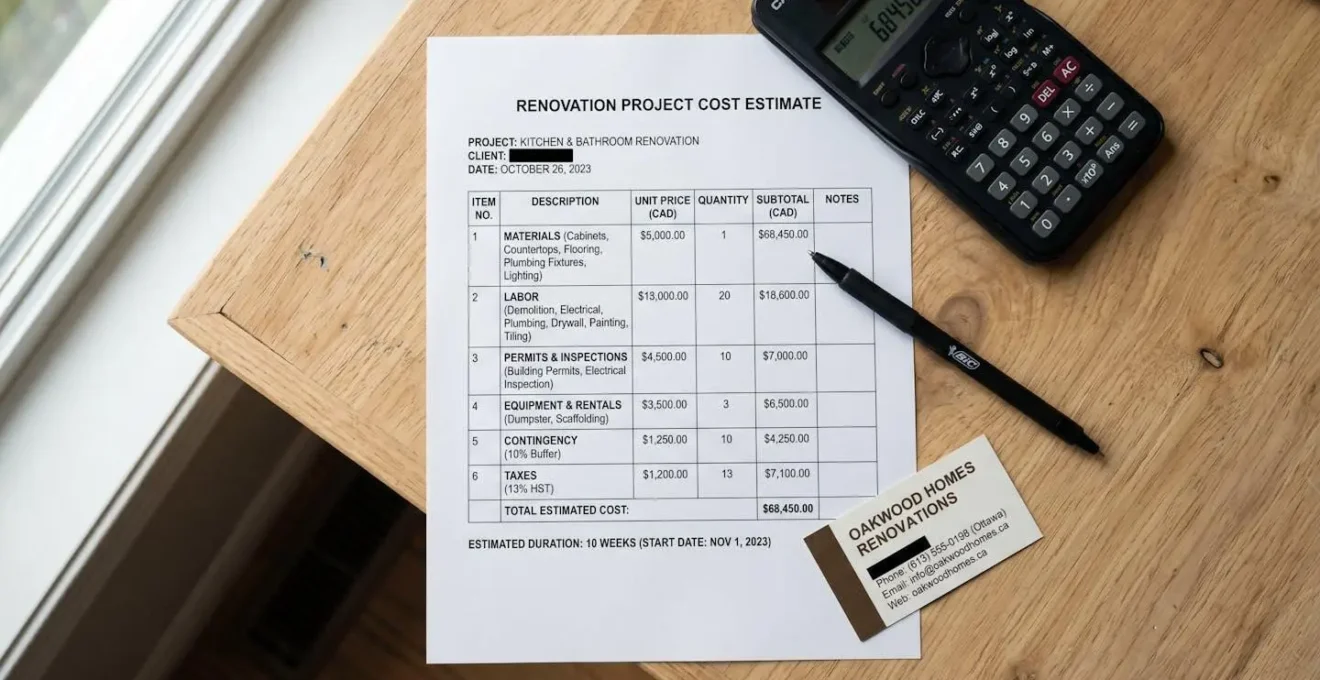
Under Ontario Consumer Protection Act contractor obligations, deposits of no more than 10% of total project cost are recommended, with payment schedules tied to completion milestones rather than arbitrary calendar dates or contractor cash-flow needs. While industry practices sometimes see deposits reaching 30-35% to secure materials for larger projects, any request exceeding half the contract value before substantial work completion represents a significant warning pattern. Consumer protection agencies consistently report that payment disputes drive the majority of renovation complaints—homeowners who pay too much upfront lose negotiating leverage if quality issues or delays emerge.
An itemized estimate breaking down material costs, labor hours, permit fees, and contingencies enables accurate comparison between competing bids, reveals whether the contractor understands project complexity, and establishes baseline pricing for evaluating change orders. Contractors who resist itemization or provide only vague category totals (“materials: $15,000”) often hide inflated markups or plan to introduce surprise costs mid-project.
| Payment Element | Professional Standard | Red Flag Pattern | Your Response |
|---|---|---|---|
| Upfront deposit | 10-35% of total cost, documented in written contract | More than 50% demanded before work starts | Request milestone-based schedule with deposits under 35% |
| Payment milestones | Tied to completion stages (demolition done, framing complete, fixtures installed) | Vague timing based on calendar dates or “when we need materials” | Demand specific completion criteria for each payment release |
| Documentation | Itemized estimate with separate material/labor breakdown | Verbal quote only or single lump sum without detail | Require written, itemized proposal before proceeding |
| Final payment | 10-15% retained until final walkthrough and deficiency resolution | Full payment demanded before completion or final inspection | Retain holdback until all deficiencies resolved to satisfaction |
Change order procedures deserve explicit discussion during initial negotiations. Professional contractors establish upfront how unforeseen conditions—hidden structural issues, outdated wiring, or design modifications—will be documented, priced, and approved. Require written change orders specifying cost adjustments and timeline impacts, signed by both parties before work begins. Contractors preferring verbal agreements create fertile ground for disputes when final invoices arrive.
Understanding timelines and communication
Timeline questions reveal whether the contractor understands project complexity and establish accountability mechanisms preventing indefinite delays. Rather than asking “how long will this take?”—which invites vague responses—request a written schedule identifying start date, major phase completion targets (demolition, rough-in, finishing), and final completion date, along with explicit discussion of factors that could extend timelines and how delays will be communicated.

Building permit processing times directly impact project schedules. Contractors should clarify who handles permit applications, typical approval duration for your project type, and whether the timeline quote includes time for the approval process. Failing to address these details upfront often results in homeowners misunderstanding why work hasn’t started weeks after contract signing.
Communication protocol establishment prevents contractor ghosting—when homeowners can’t reach their contractor despite active work. Before signing, ask: Who serves as the primary point of contact? What’s the expected response timeframe for questions (same day, within 24 hours)? How frequently will progress updates occur (weekly calls, site meetings, email summaries)? Contractors committed to professional service answer these questions confidently and often include communication terms in their contracts. Those who dismiss such inquiries as micromanagement frequently become unreachable when issues arise.
Securing warranties and dispute resolution
Warranty questions measure contractor confidence—professionals who stand behind their work provide written warranties willingly, while those planning to disappear after final payment resist documentation. The most frequently overlooked red flag involves contractors offering verbal assurances (“don’t worry, if anything goes wrong we’ll take care of it”) without committing terms to writing. Verbal warranties become unenforceable the moment a dispute arises, providing no actual recourse when defects appear.

Comprehensive written warranty clauses specify three essential elements: coverage duration (typical periods range from one to five years depending on work type), scope definition (which aspects are covered and which exclusions apply), and claim procedures (how homeowners report defects and what response timeline the contractor commits to). Scrutinize exclusion language carefully—overly broad exclusions like “damage from normal use” can render warranties nearly useless by allowing contractors to attribute any defect to excluded causes.
Dispute resolution mechanisms deserve explicit discussion before conflicts arise. Ask how the contractor handles disagreements about workmanship quality, scope interpretation, or final payment amounts. Professional operators often include mediation or arbitration clauses in contracts—these alternative dispute resolution methods resolve conflicts faster and less expensively than court proceedings. Contractors who refuse to discuss dispute scenarios or insist “we never have problems” signal unwillingness to address accountability. The most reliable partnerships establish fair resolution procedures upfront rather than leaving homeowners’ only option as expensive legal action or accepting substandard results.
Critical distinction: Tarion Warranty Corporation coverage does NOT extend to renovation projects—only new home construction. This makes contractor-provided written warranties essential, as they represent your primary protection against defects.
How can I verify a contractor’s WSIB clearance in Ontario?
Request the contractor’s WSIB account number and clearance certificate directly—legitimate contractors provide this documentation immediately upon request. While the WSIB website offers verification tools, the most straightforward approach involves asking the contractor for their current clearance certificate (typically valid for specified periods) and confirming the document shows active status with no outstanding compliance issues. Contractors operating legally maintain these records and share them without resistance as standard practice.
Is it normal for contractors to ask for a deposit before starting work?
Yes, upfront deposits are standard industry practice to secure materials and scheduling—professional contractors typically request 10-35% of total project cost as initial payment. The Ontario government recommends deposits not exceeding 10% of the contract value, though larger projects sometimes justify deposits up to 35% to cover material procurement. However, any request exceeding 50% of the total cost before substantial work completion represents a significant red flag warranting extreme caution or outright rejection of that contractor’s proposal.
What should I do if a contractor won’t provide a written estimate?
Treat refusal to provide written estimates as an immediate disqualifier and seek other candidates—this practice violates Ontario’s Consumer Protection Act requirement for written contracts on projects exceeding $50 and signals either incompetence or intentional avoidance of accountability. Professional contractors provide detailed written proposals as standard operating procedure, understanding that homeowners need documented pricing to make informed decisions and protect themselves legally. Verbal-only quotes offer zero enforceable protection if disputes arise over scope, cost, or quality.